Brody Hopkins, Ryan Clifford Headline 10 Statcast Standouts (June 8)

Image credit: Brody Hopkins (Photo by Brace Hemmelgarn/Minnesota Twins/Getty Images)
Every Monday morning, we highlight 10 players who stood out to us based on their underlying Statcast metrics. Data will usually be through Saturday of that week, but may include some data from Sunday games. These are not full scouting reports, but often serve as good early indicators of prospects who might be ready to break out or are demonstrating MLB-ready skills.
Last week, we dove into Joshua Báez‘ scintillating potential and discussed what that might mean for Kevin Roberts Jr. in this year’s draft class. This week we’ll discuss:
- Josh Norris’ insight on Brody Hopkins
- The key to unlocking Ryan Clifford
- An under-the-radar prospect to know
- The Guardians developing a power-over-hit prospect
- Quinn Mathews potentially turning a corner
- The next Spencer Jones?
- Breakout prospects in the Jays & Phillies organizations
- College Pitcher Spotlight: Notre Dame’s Jack Radel
10 Statcast Standouts
Brody Hopkins, RHP, Rays
Josh Norris’ tweet about Hopkins points to a change in his delivery that has perhaps unlocked command—the one remaining piece of his prospect puzzle. Let’s take a look at what Hopkins looked like in his latest start from an arsenal standpoint:
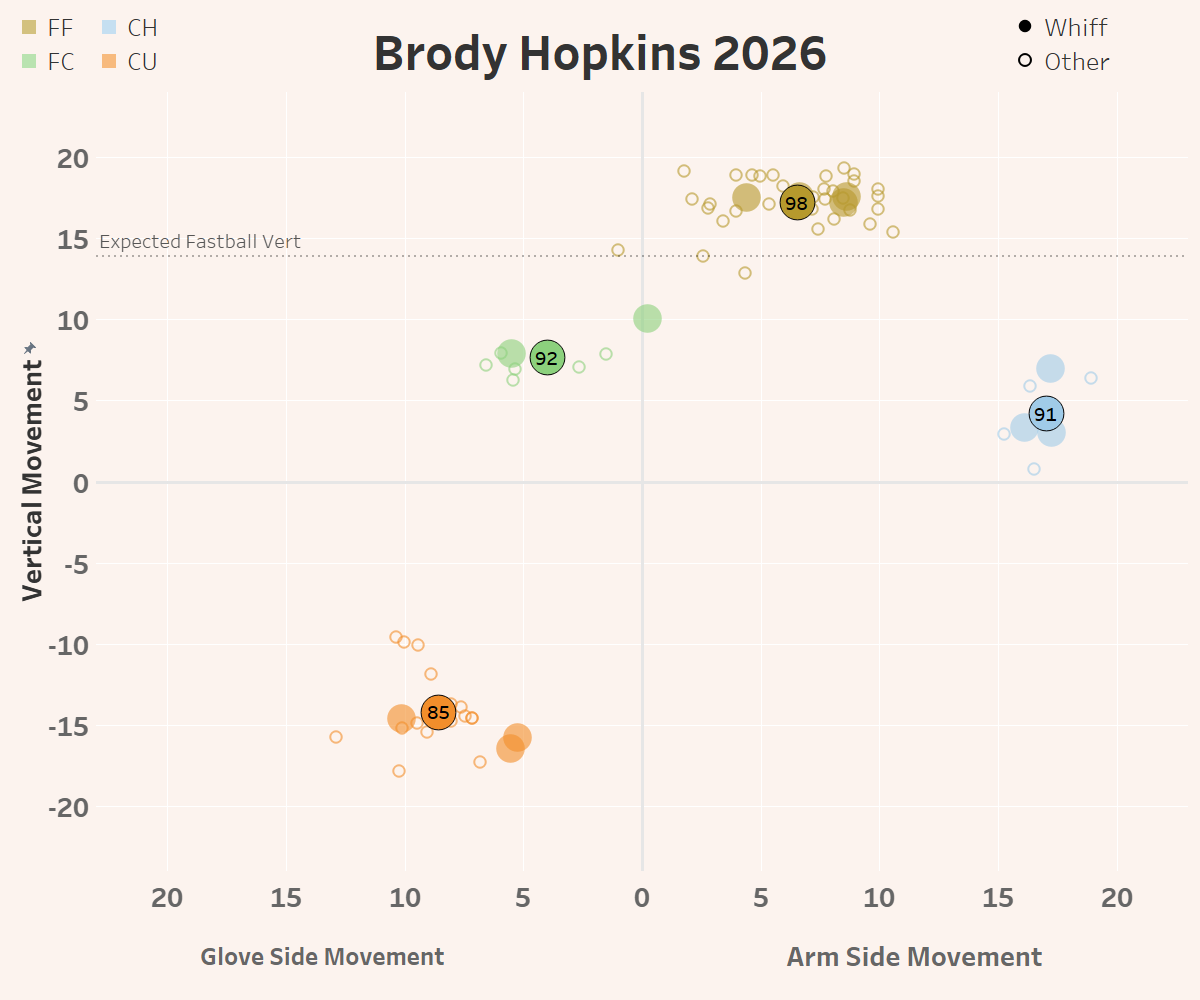
Hopkins represents the platonic ideal of a power pronator, featuring a fastball with 80-grade shape. The key performance indicator for a riding fastball is how much ride the pitch gets compared to the pitcher’s arm angle. The MLB leader this year is Eury Perez, who is featuring 3.2 inches of vertical ride above expected. Hopkins’ fastball is very close to that, averaging about 3.0 inches of vertical ride. This is easily seen in his arsenal chart above, which shows his fastball sitting comfortably above the expected vert line. From a pure stuff perspective, this combination of velocity and shape would be top five among starting pitchers in baseball.
A great fastball alone does not make an arsenal. Hopkins’ curveball has huge depth at 85-86 mph, making it an absolute weapon when he locates it well. It’s more than just a swing-and-miss offering, as its downward tilt forces hitters to be on top of the ball, resulting in an average launch angle of -9.4 degrees and a corresponding .286 slugging on contact.
The changeup is an easy plus-plus pitch, drawing chase swings at a 40% clip, along with an elite 62.5% whiff rate when batters swing at the pitch. His lone weak spots are perhaps the cutter and the absence of a true gyro slider closer to the 0/0 mark on the chart. Early in the season, the cutter was Hopkins’ go-to command pitch, but he’s now deemphasized the pitch in favor of more fastballs.
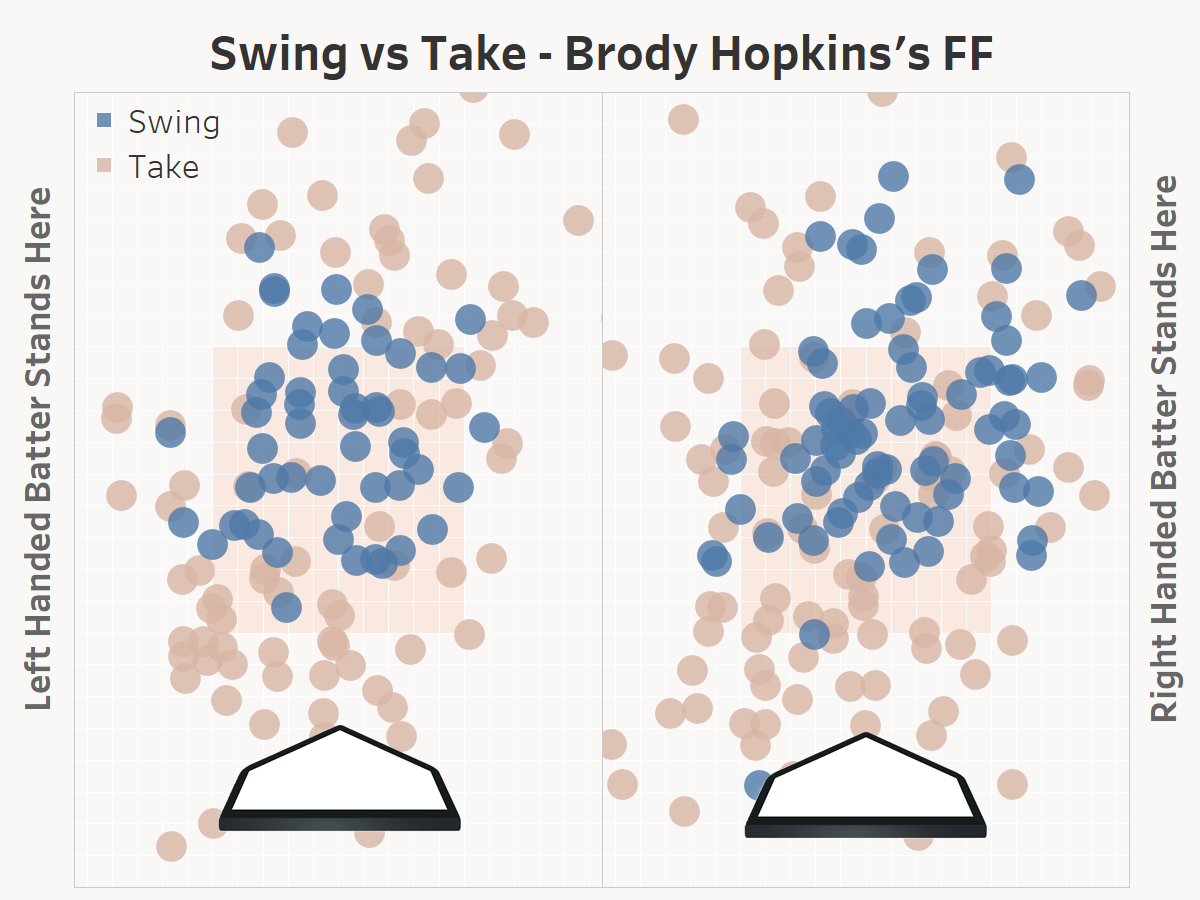
Here’s what Hopkins’ fastball command looked like to start the season:
Let’s compare that to his last three starts:
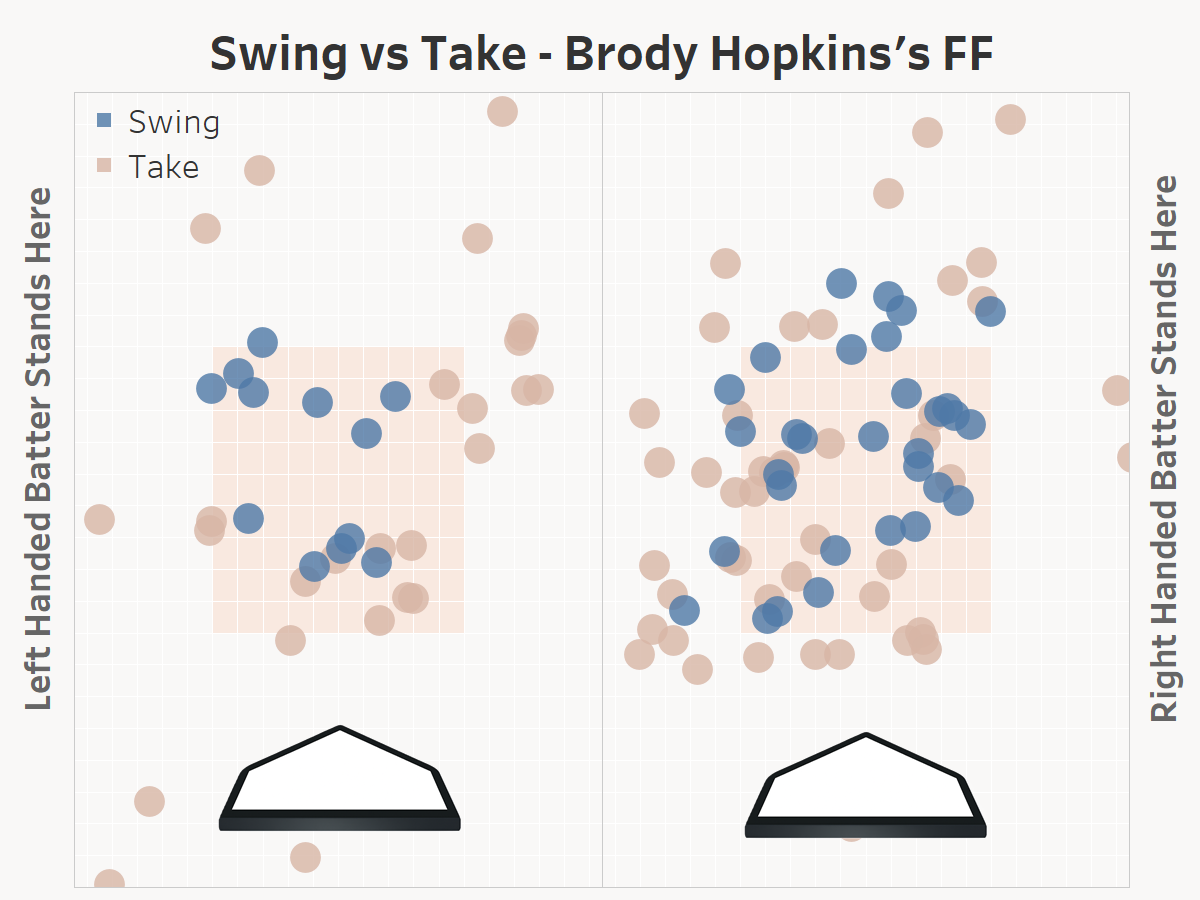
His command still isn’t great, but there is a key difference: Hopkins has mostly cut out the bad misses below the zone and the extremely bad misses above the zone. This has two positive network effects. The obvious one is that fewer bad misses means fewer easy takes for the batter. This is blatantly obvious in the first chart, where virtually all of the below-zone pitches were taken by the batter. The more important effect is movement synergy (aka tunneling) with his breaking ball and changeup. Hopkins has so much vertical separation on his fastball compared to his changeup and curveball that he has to throw his fastball high so that the other pitches follow similar trajectories early in their path.
The early data certainly supports Norris’ observation. If it’s a true talent change that holds up over the long run, Hopkins may very well be on his way to becoming one of the top pitching prospects in baseball.
Ryan Clifford, 1B, Mets
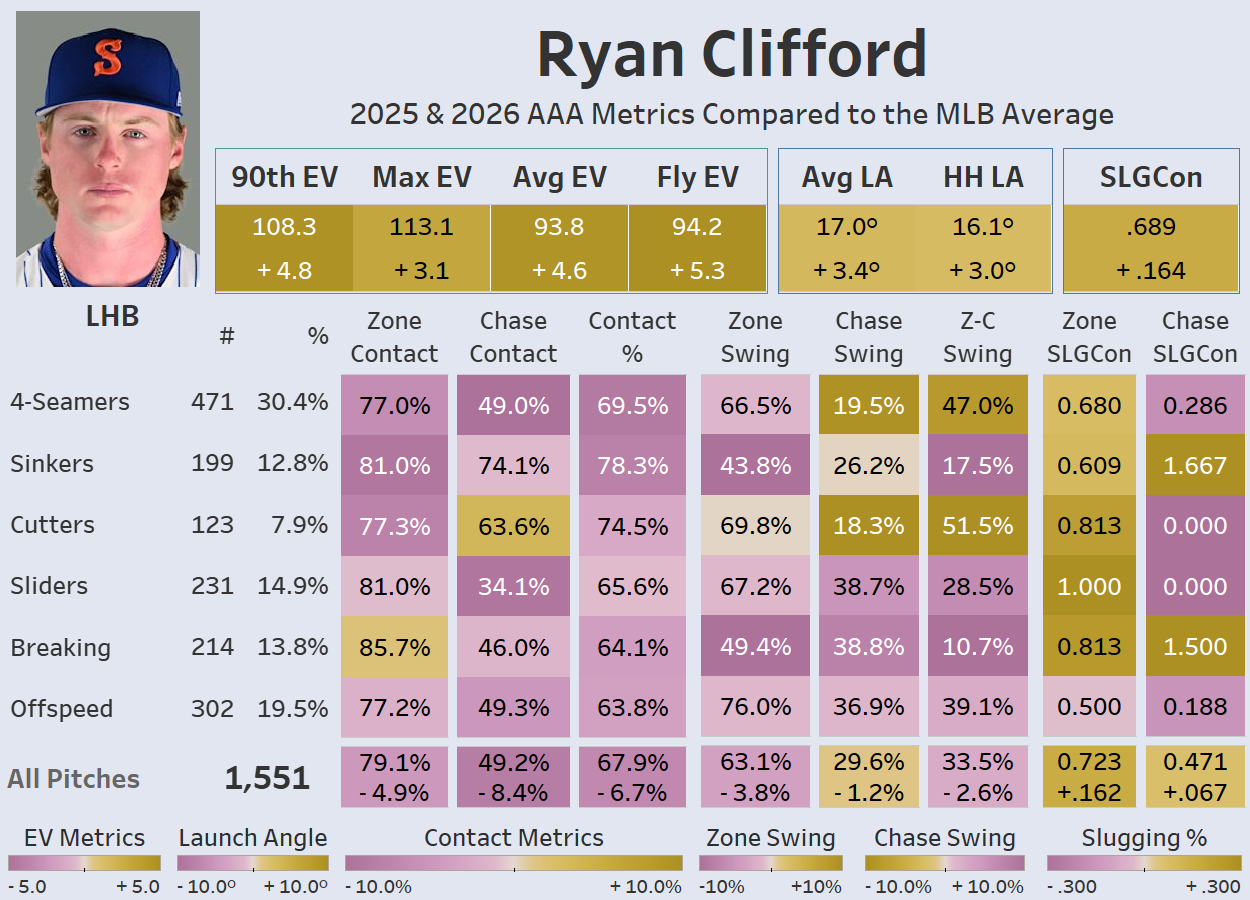
Between this year and last year, we have a substantial amount of data on Clifford. The top line is very clearly excellent, giving him an easy plus-plus power grade. This is reflected in his batted-ball performance with a healthy .723 slugging on contact against in-zone pitches. His power does come at the cost of questionable contact skills against both righties and lefties. This is usually a good tradeoff for most hitters, which brings us to the key issue in the profile: chase rates.
You may raise a skeptical eyebrow at that statement if you only look at the bottom line chase swing %, which looks to be slightly better than average. With a sample of over 1,550 pitches, a clear pattern is emerging: Clifford won’t chase fastballs and cutters, but he will chase breaking balls, sliders and changeups at alarming rates. This makes him superficially look like he has decent swing decisions, when in fact, he does not. He’ll need to drastically improve in this aspect. If he does, he has 30-35 homer upside.
Rorik Maltrud, RHP, Guardians
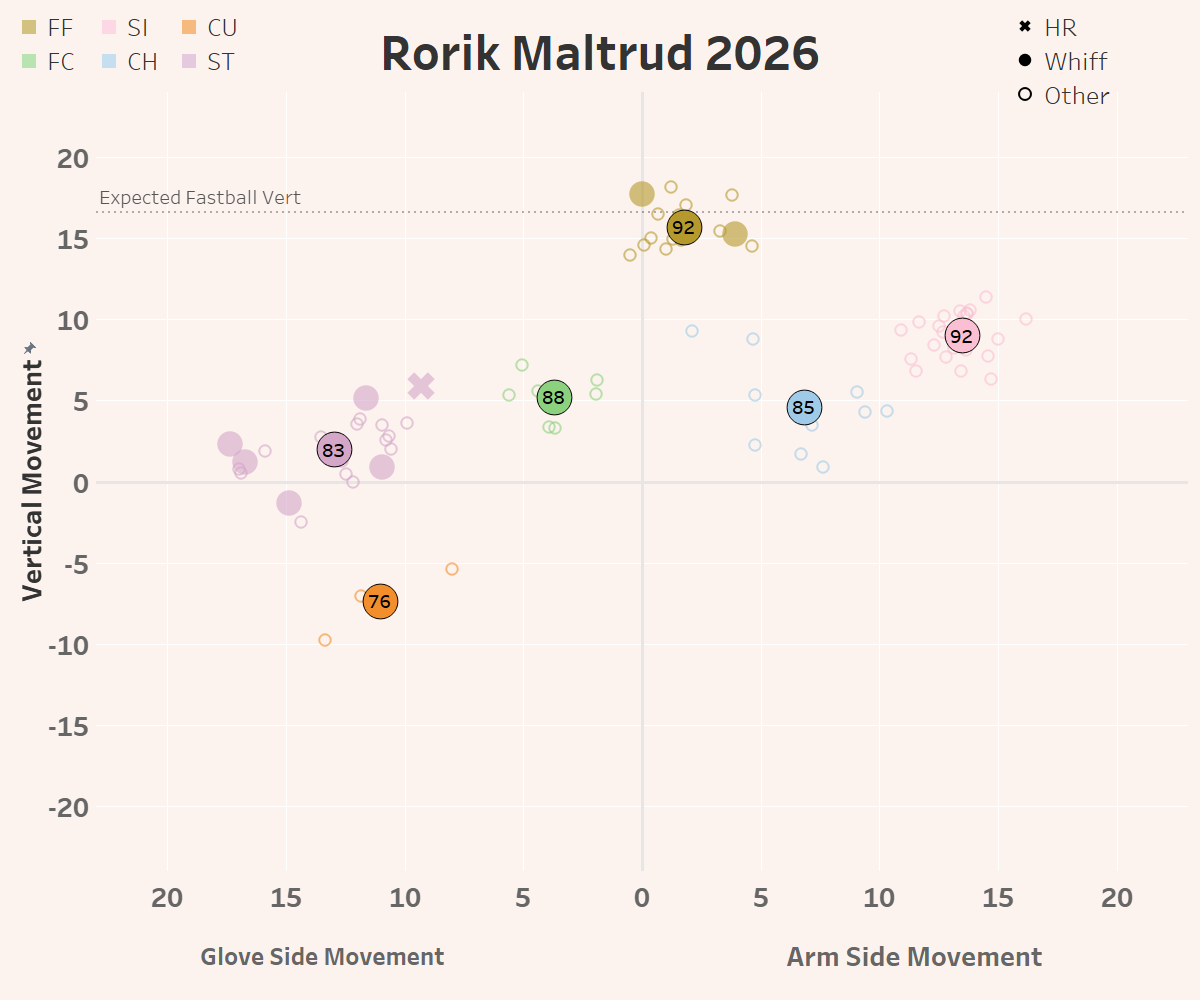
Maltrud won’t jump off the page. He’s older at already 26 years old and in his first season at Triple-A. His fastball sits at a pedestrian 92 mph without great shape. He was signed as an undrafted free agent, has never been on any of BA’s draft lists and has never graced a Top 30 list. If there ever was a prospect who defined “under the radar”, it would be Maltrud.
Despite all that, he’s been a very good pitcher at every level he’s competed at, and he’s exactly the type of player we love to cover in this series. How does one succeed without a plus fastball? Usually by taking a kitchen-sink approach and mixing a lot of different pitches that look similar out of the hand.
Weapon No. 1 is having two fastballs that come out of the hand identically from a velocity and spin axis perspective. Seam-shifted wake effects make those pitches have drastically different shapes, allowing them to play up above their raw stuff qualities. The rest of the arsenal builds off this principle: A bridge cutter/slider at 86-88 mph that splits the east/west profile for the sweeper, as well as a changeup that doesn’t have ideal shape, but sits between the sinker and fastball horizontally.
This all adds up to five pitches that perform well enough, without any one pitch being a weapon in and of itself, giving Maltrud a realistic shot as a back-of-the-rotation type of arm. That would be a fantastic outcome for a player this off the radar.
Kahlil Watson, OF, Guardians
For many years, the Guardians have had a reputation of developing hit-over-power guys. That may be changing, with a prime example being Watson:
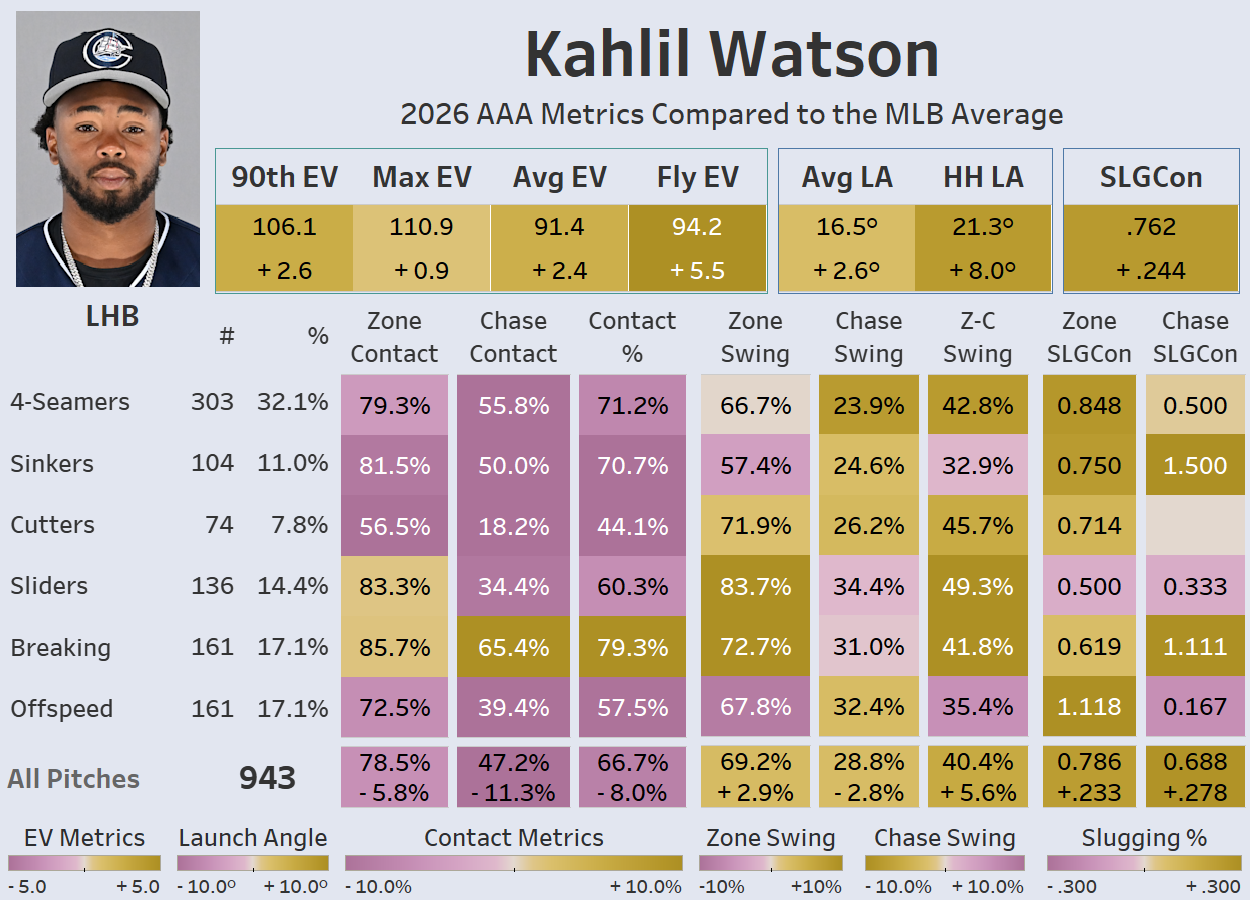
Watson is remarkably consistent across most pitch types, with similar contact, damage and chase rates across the board. He’s aggressive without chasing too much, and he’s been generating near-ideal launch angles, making his plus raw power play up.
If we look at his performance against lefties, we see very similar numbers:
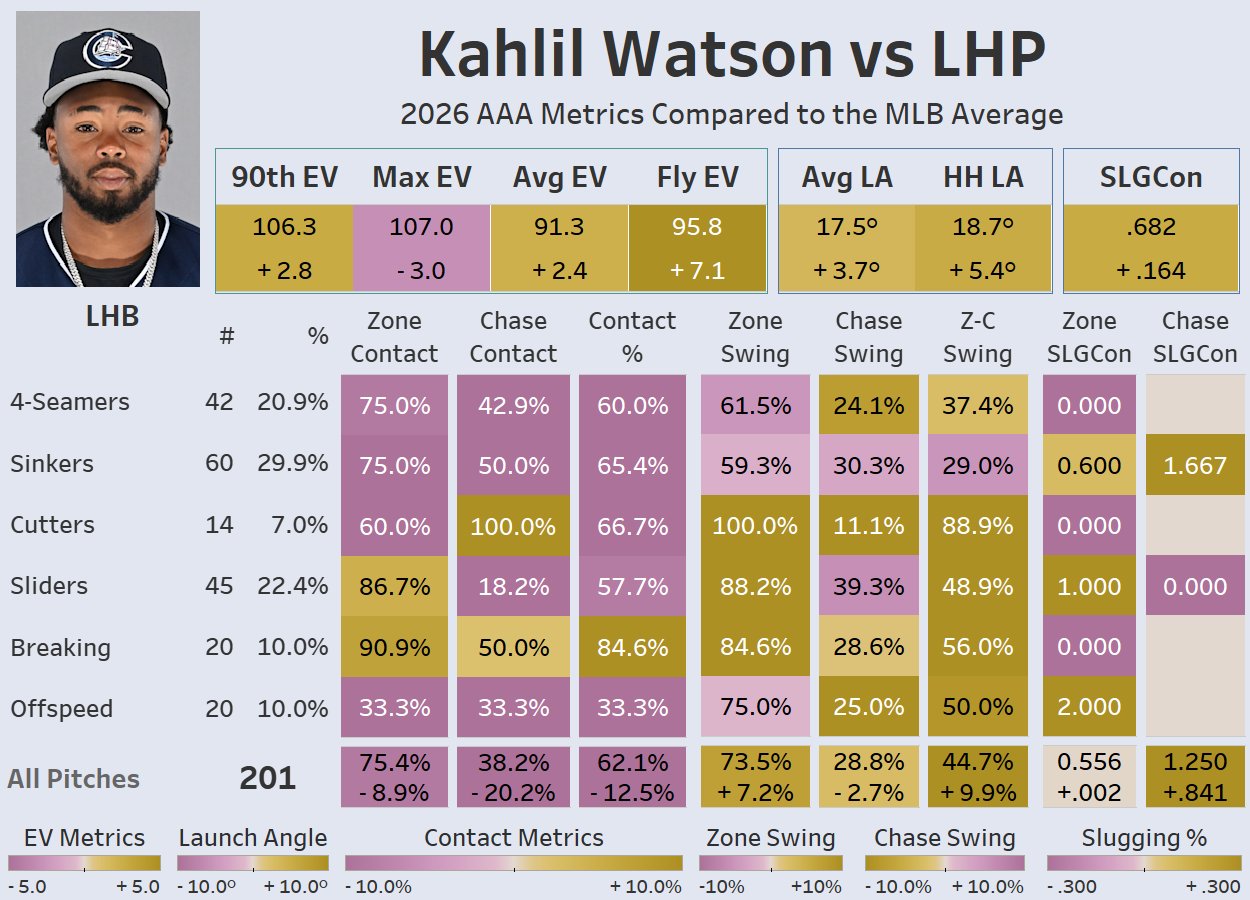
Watson clearly has struggled to make contact when he chases against samehanded pitchers, but his approach is generally sound, which means that his chase contact rate is not a dealbreaker on its own. His metrics very much support his 120-125 wRC+ at Triple-A, and he should be able to get close to that at the major league level.
Quinn Mathews, LHP, Cardinals
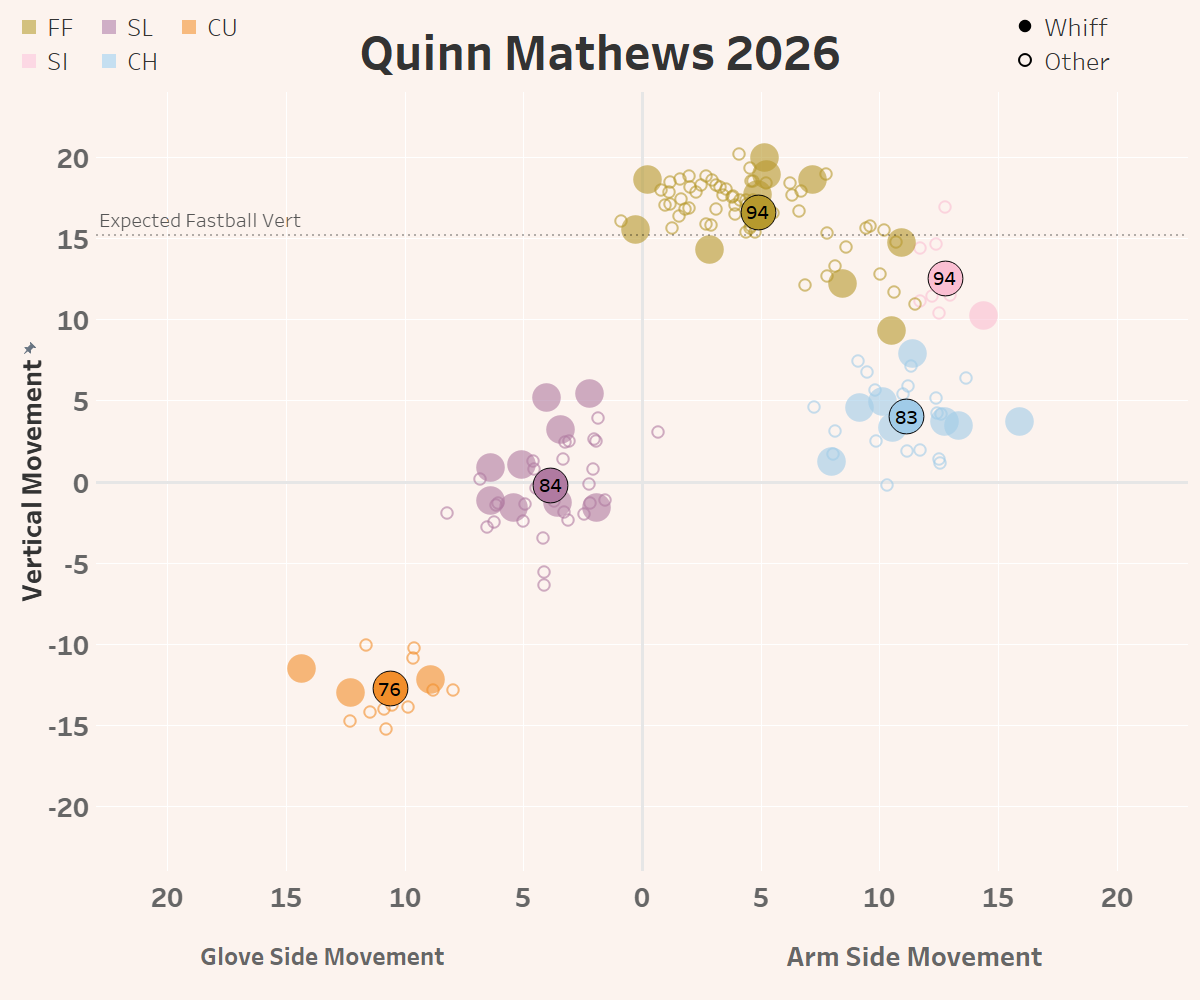
Mathews has taken a couple of important incremental steps forward this season. First, his fastball has regained some vertical ride and is now looking like a plus pitch again, even at 94 mph. Second, he’s improved his seam-shifted wake sinker so that it gets more depth and plays better off the fastball. Third, his slider is getting even more depth than last season, often flirting with deathball shape. It’s turned the pitch into a potentially plus weapon, as well, despite sitting at just 84 mph. Lastly, he’s added a couple of inches of drop to the curveball while maintaining the same velocity. His changeup, meanwhile, remains an effective chase pitch, inducing swings on 32% of pitches out of the zone.
When Mathews burst onto the scene in 2024, he was striking out lots of batters and not really walking anyone. Then he hit Triple-A and hasn’t been able to limit walks. The stuff has now progressed to the point where we can hope that the command he showed from before Triple-A will come back. When combined with his new stuff, it could turn him into a top pitching prospect once more. He certainly looked like one in his last outing:
Quentin Young, SS, Twins
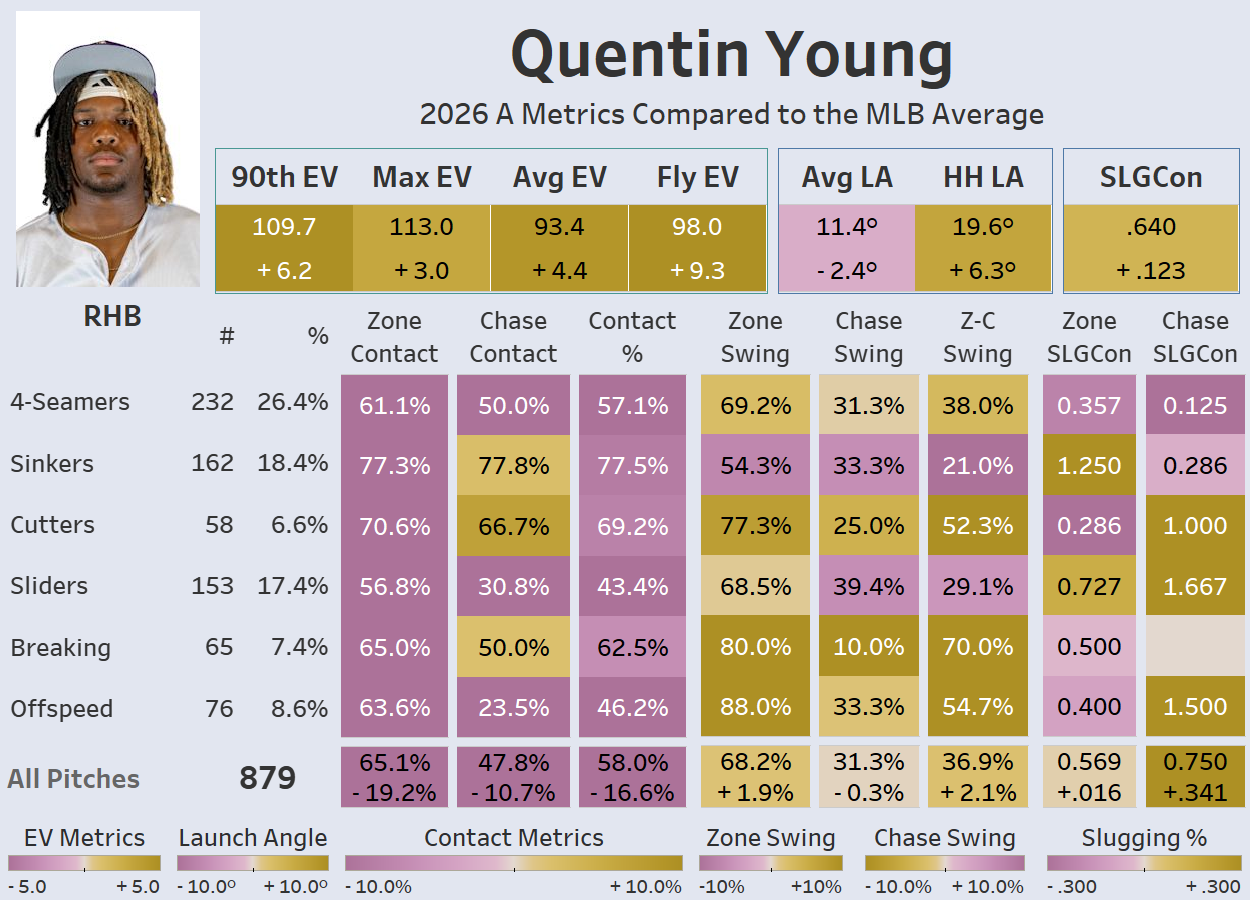
If you’re looking for the next Spencer Jones type, look no further than Young. We’re talking huge hit tool questions with gargantuan raw power—arguably 80-grade based on some of his exit velocity and launch angle metrics. Profiles of this nature rarely work out long term, but they offer tantalizing potential when they do.
Don’t write Young off just yet, despite the woeful zone-contact numbers and poor performance track record to date.
Yaqui Rivera, RHP, Orioles
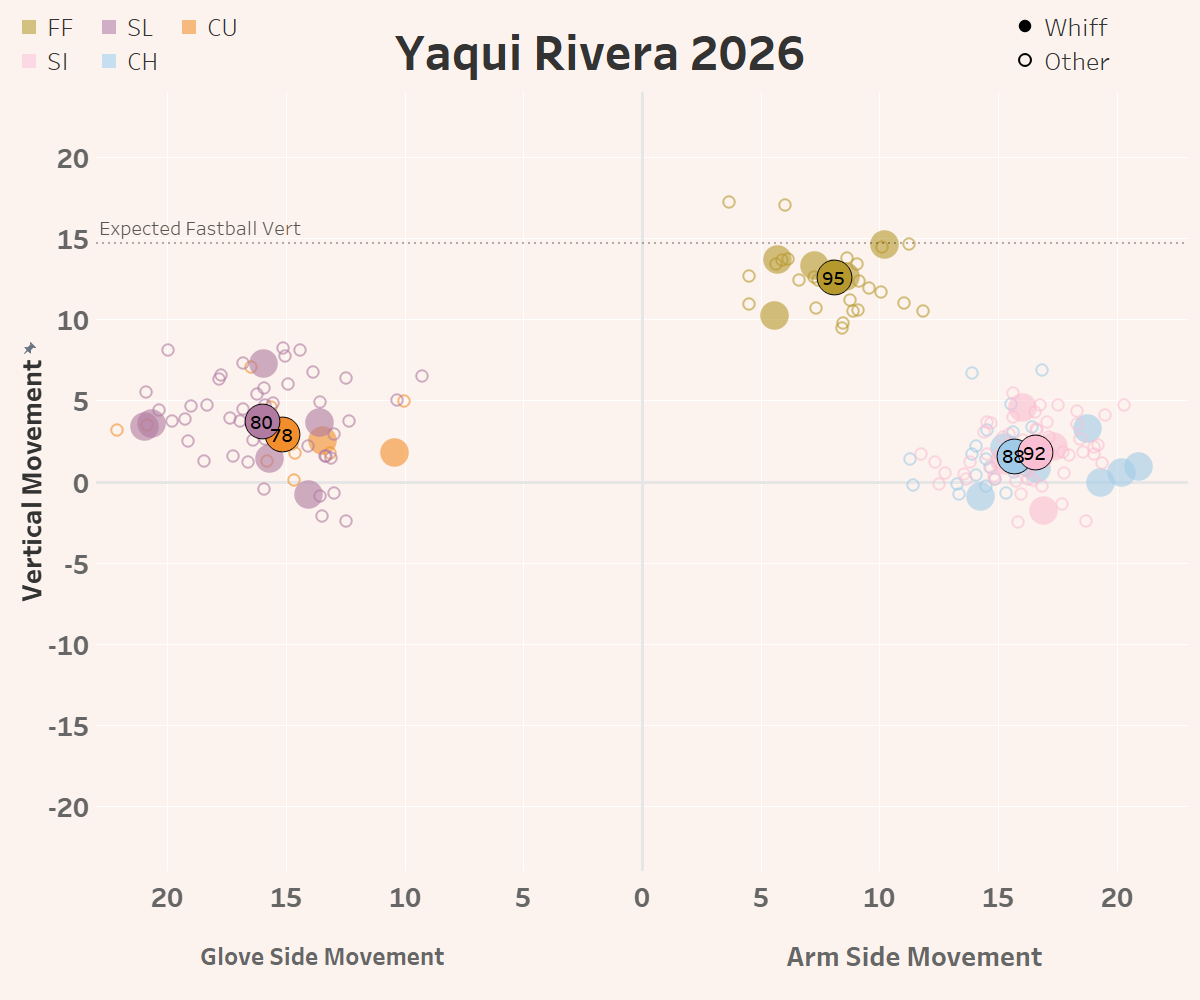
It’s hard to tell if Rivera throws a sinker and a changeup or if it’s an Edward Cabrera-type of pitch. Either way, the slower variant, which is labeled a changeup, gets monstrous whiff rates and probably looks identical to the sinker while arriving a little bit later.
He complements that with a tremendous sweeper that touches 20 inches of horizontal movement with a healthy dose of seam-shifted wake movement. This helps him mask his otherwise pedestrian fastball, which he throws only 17% of the time.
There isn’t a ton of upside here, but Rivera should be effective against righty-heavy lineups, perhaps as a bulk reliever.
Aldo Gaxiola, 3B, Blue Jays
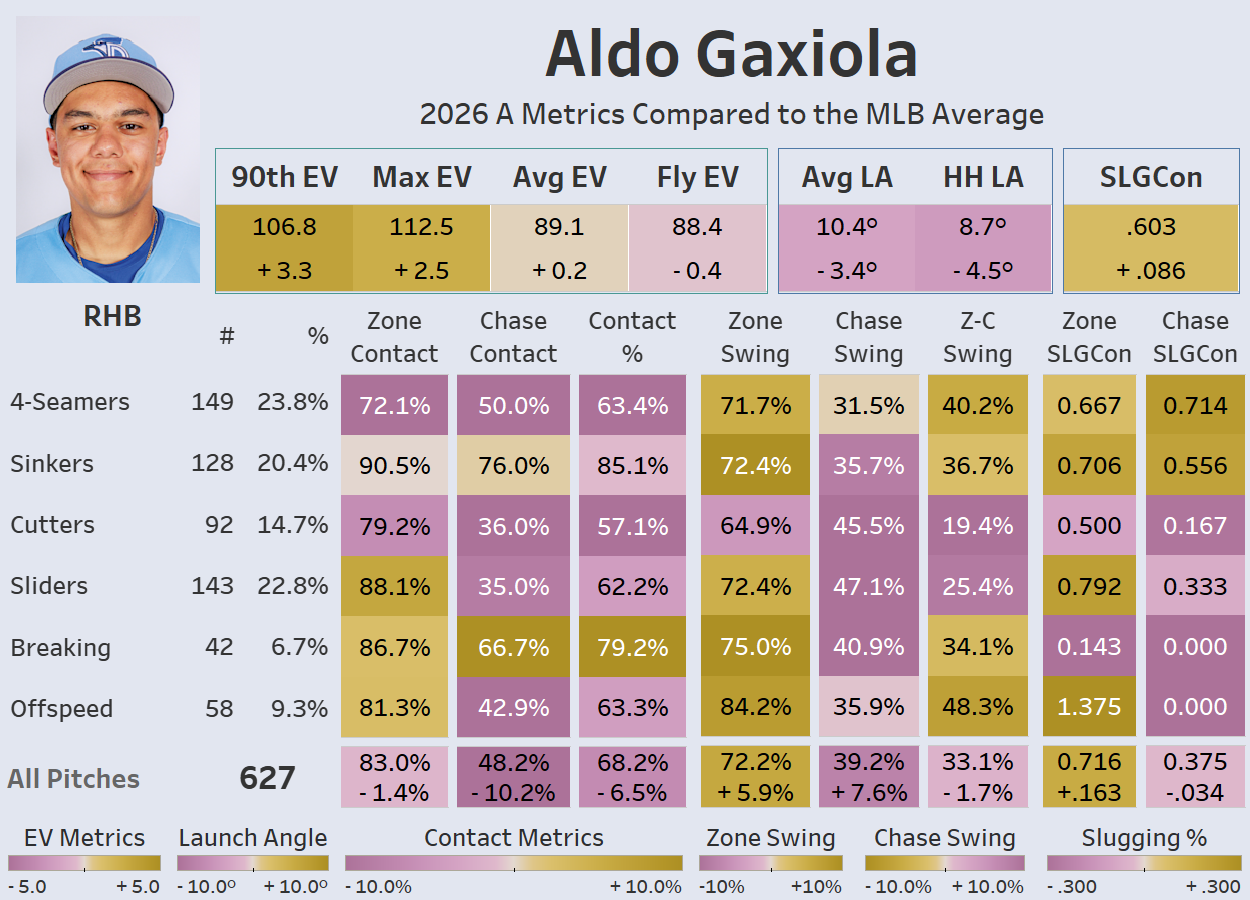
Profiles like Gaxiola’s are often straightforward to analyze. They show good raw power with limited home run potential due to poor launch angles, excess aggression that will limit walks and they often lead to less-than-ideal overall contact quality. That has translated to a .258/.316/.429 slash line in Single-A for Gaxiola, which is ever so slightly above average. It’s difficult to find many 19-year-old prospects with present plus raw power and decent contact metrics. A more selective approach may improve his zone contact, as well.
Small gains in patience, launch angles or zone contact might help put Gaxiola on the map as a rising star in the Blue Jays’ system.
Alirio Ferrebus, C, Phillies
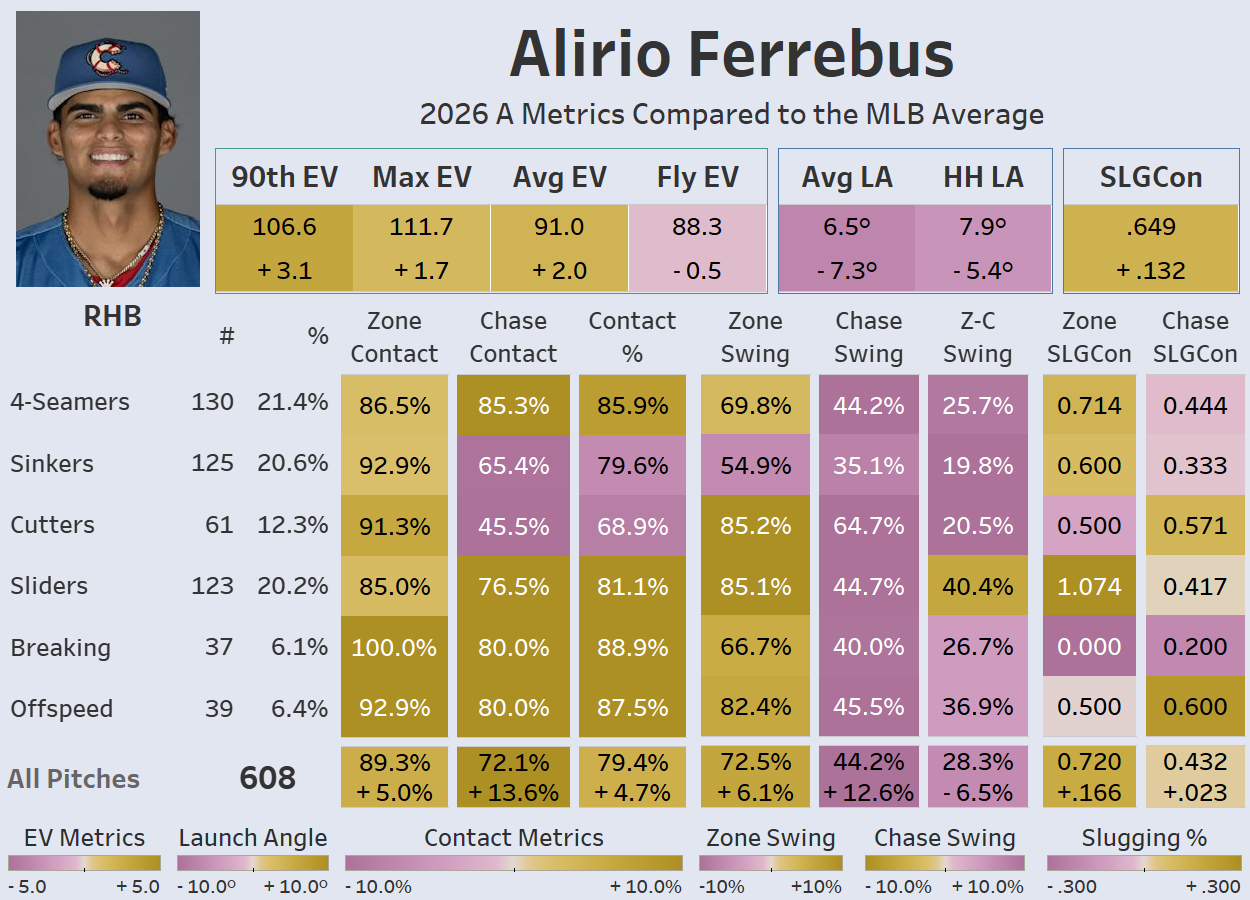
Ferrebus is having a breakout season, hitting .335/.383/.547, and it’s easy to see why. He’s extremely aggressive but consistently barrels the ball and rarely swings and misses, even when he chases. For many batters, this is a gift and a curse. They can get to any pitch, so they swing at everything, often to their detriment.
Given his scouting profile as a potentially league-average catcher, he could be a candidate to join the Top 100 with modest gains in plate discipline. Ferrebus is a name to know in the Phillies’ system.
College Pitcher Spotlight
Jack Radel, RHP, Notre Dame (No. 38 on BA’s 2026 Draft Board)
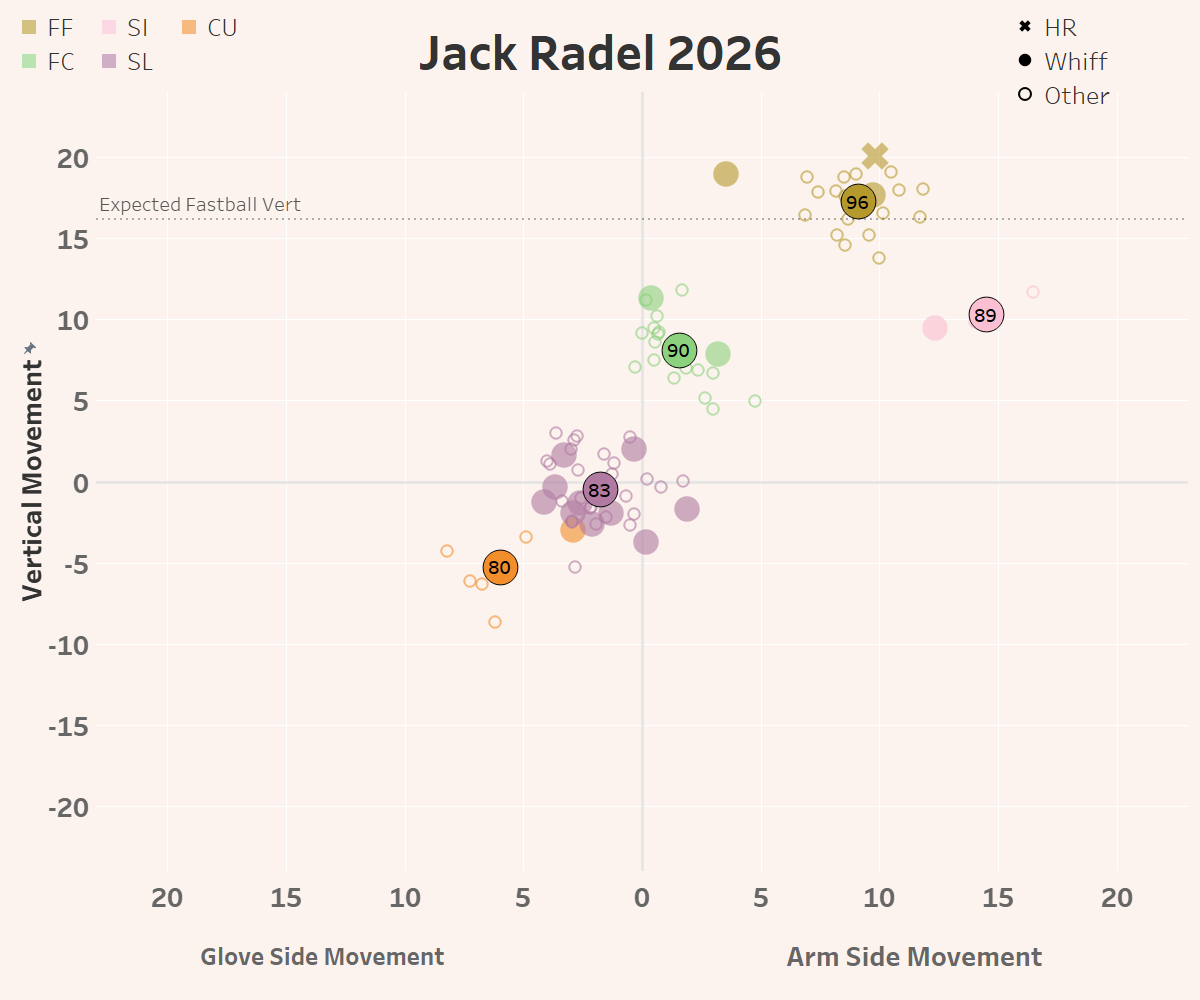
Radel ticks a lot of boxes. He has a starter’s frame at 6-foot-5 and features a fastball at 96 mph with average shape. He’s improved every season, ranking 20th this year in K%-BB%.
What makes Radel intriguing is how much room for optimization there is in his profile while also having such a solid base of pitches already. His primary swing-and-miss weapon is a deathball slider that likely needs a couple more ticks of velo to truly stand out. He already features a bridge cutter that helps the fastball and slider play up. His changeup has good velocity separation but could likely benefit from seam-orientation and perhaps some grip adjustments to improve its shape. Similarly, his curveball would likely benefit from more depth and horizontal movement.
It’s a starter’s starter package, with three pitches that fit in a modern arsenal (fastball, cutter, slider) and two that will need some work to get them up to par. Radel could be a target for teams that feel he has room to grow in all of his pitches.